

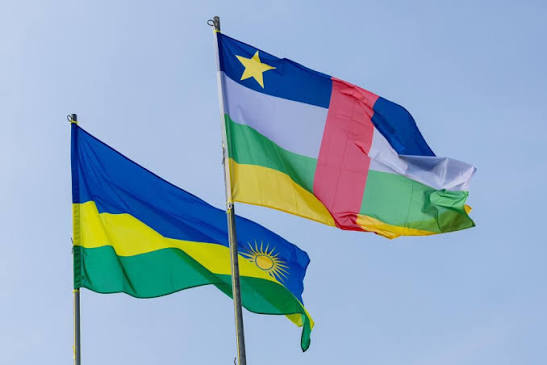
Under Rwandan security officers supervision, Central Africans are voting in the presidential election this Sunday, December 28 202
Citizens of the Central African Republic woke up early on Sunday, December 28, 2025, to take part in presidential and legislative elections held under tight security, largely supervised by Rwandan security forces.
The polls are expected to be closely contested, though President Faustin Archange Touadéra is widely seen as the frontrunner, with strong chances of securing a third term in office.
More than 2.3 million registered voters are eligible to cast their ballots. In addition to electing the President, voters are also choosing members of the National Assembly, as well as regional and municipal leaders.
A total of seven candidates are competing for the presidency. Among them are former Prime Ministers Anicet Georges Dologuélé and Henri-Marie Dondra. Dologuélé finished second in both the 2015 and 2020 presidential elections, while Dondra served as Prime Minister from June 2021 to February 2022.
Despite the presence of experienced political figures in the race, President Touadéra, a former mathematics lecturer, remains the favorite. He entered politics in 2008 after being appointed Prime Minister by then-President François Bozizé, a position he held until 2013 when the government was overthrown by a rebel coalition.
After three turbulent years of political transition marked by widespread violence, Touadéra ran for president and won, largely due to his image as a neutral figure with no direct ties to the armed groups Séléka and Anti-Balaka, which had plunged the country into conflict.
He has since been credited with contributing to the restoration of relative peace and stability in the Central African Republic, following years of devastating civil war. A key factor in this progress has been security cooperation with Rwanda, whose forces have played a significant role in stabilizing the country.
Rwandan security forces were again instrumental in ensuring a peaceful voting process during the current elections, securing many areas and performing duties that have often proven challenging for United Nations peacekeeping troops.
As voting continues, both domestic and international observers are closely watching the process, hoping the elections will further strengthen peace, stability, and democratic governance in the Central African Republic.