

“We were not surprised “Rwanda Government reacts on DRC decision to finally reject to sign the agreement of the economic cooperation (the REIF) , The Regional economic integration framewok in U.S
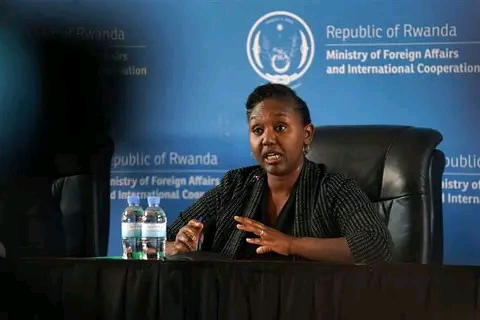
” We didn’t expect the DRC decision at the final minute of refusing to sign the Regional economic integration framework (REIF). Although during the conversations that made the agreement be reached ,there were good senses, and the great work of mediation from Massad Boulos and the U.S government.”The message from Yolande Macron, Spokesperson of Rwanda Government
It was scheduled that this last Saturday, October 04.2025 , the two countries would have to sign the agreement on economic cooperation , the REIF, Regional economic integration framework in U.S ,for the U.S is the countries main mediator. However, unfortunately, the RDC delegate refused to sign the agreement at the final minute, and for unknown reasons.
Signing agreements with President Félix Tshisekedi Tshilombo has continued to prove difficult because of his unpredictable nature, as President Paul Kagame once remarked during a press conference.
The Government of Rwanda stated that it was not surprised when the signing of the economic cooperation agreements was halted at the last minute on the orders of President Tshisekedi, who instructed the DRC delegation—previously assigned to work with Rwanda’s team—to withdraw from the process.
The Minister of Foreign Affairs and International Cooperation, Ambassador Olivier Jean Patrick Nduhungirehe, said this behavior has been consistent over the past three years, especially regarding peace and security negotiations.
While explaining why Rwanda and the DRC failed to sign the long-prepared economic agreements, Minister Nduhungirehe said:
“I can say that since the peace talks began three years ago, we have become used to President Tshisekedi’s outbursts and reversals on key issues related to peace and security in our region.”
He explained that the fact is that both Rwandan and Congolese teams worked diligently, with support from the United States, to prepare the Regional Economic Integration Framework (REIF) agreements.
When the delegations were ready to approve the document they had worked on for a week, President Tshisekedi gave last-minute instructions on Friday morning ordering the DRC team not to sign—apparently fearing the political backlash such a move might cause among the domestic public.
International media outlets reported that Tshisekedi may have suspended the signing of the already finalized and agreed-upon agreements because he allegedly wanted “90% of Rwandan troops to withdraw from Congolese territory” first.
Minister Nduhungirehe dismissed this as false, saying that such a precondition was never raised during the negotiations.
He said: “This excuse of ‘withdrawing 90% of Rwandan troops’ is something I only read about in the media—it’s a fabricated story meant to mislead public opinion. It was never brought up by the DRC delegation during the discussions. Even the DRC representatives in Washington were surprised by those claims.”
He continued: “In reality, the negotiations on the Regional Economic Integration Framework (REIF) concern only economic cooperation; they do not touch on security matters, which are being handled separately by the Joint Security Cooperation Mechanism (JSCM).”
Minister Nduhungirehe further explained that the JSCM last met in Washington on September 17–18, 2025, where both sides discussed the implementation of the military cooperation document known as the ‘Concept of Operations (CONOPS).’
He added: “Even the statement released by the U.S. Government after that meeting made no mention whatsoever of any demand for the withdrawal of 90% of Rwandan forces from Congolese territory.”
Minister Nduhungirehe reminded that on September 14, 2024, a delegation from the DRC army approved a joint project with Rwanda aimed at eradicating the FDLR terrorist group, during a meeting held in Luanda, Angola.
The project was also meant to be accompanied by the removal of Rwanda’s defensive measures, once the FDLR no longer posed security threats in the region.
However, President Tshisekedi later backtracked, calling the DRC Minister of Foreign Affairs, Thérèse Kayikwamba Wagner, and instructing her not to sign the agreement, even though both ministers had been ready to do so.
He said, “He called her on the phone—in the middle of the meeting—and ordered her not to sign. That’s how it happened!”
Regional political analysts say President Tshisekedi’s reversal confirms that the only language he understands is that of war, and that it will be difficult for him to embrace a peaceful path that undermines his personal interests and the long-standing cooperation between the DRC and the FDLR militia.
It is now nearly a year since the Rwandan government revealed it continues to witness evidence showing the DRC’s lack of genuine commitment to dismantle the FDLR terrorist group, which remains the root cause of insecurity in the region.
Thirty years after the 1994 Genocide against the Tutsi, which claimed over one million lives and was brought to an end, the FDLR continues to attempt to destabilize Rwanda. This is why Rwanda has maintained defensive measures to prevent the grave consequences of that group, which has been strengthened by the DRC.
Nevertheless, Rwanda has reiterated its confidence in the peace agreements and the ongoing mediation led by the United States, noting that the pending economic cooperation agreements could also be signed — as they represent one of the few remaining opportunities to promote lasting peace and sustainable development in the Great Lakes Region.
END.